
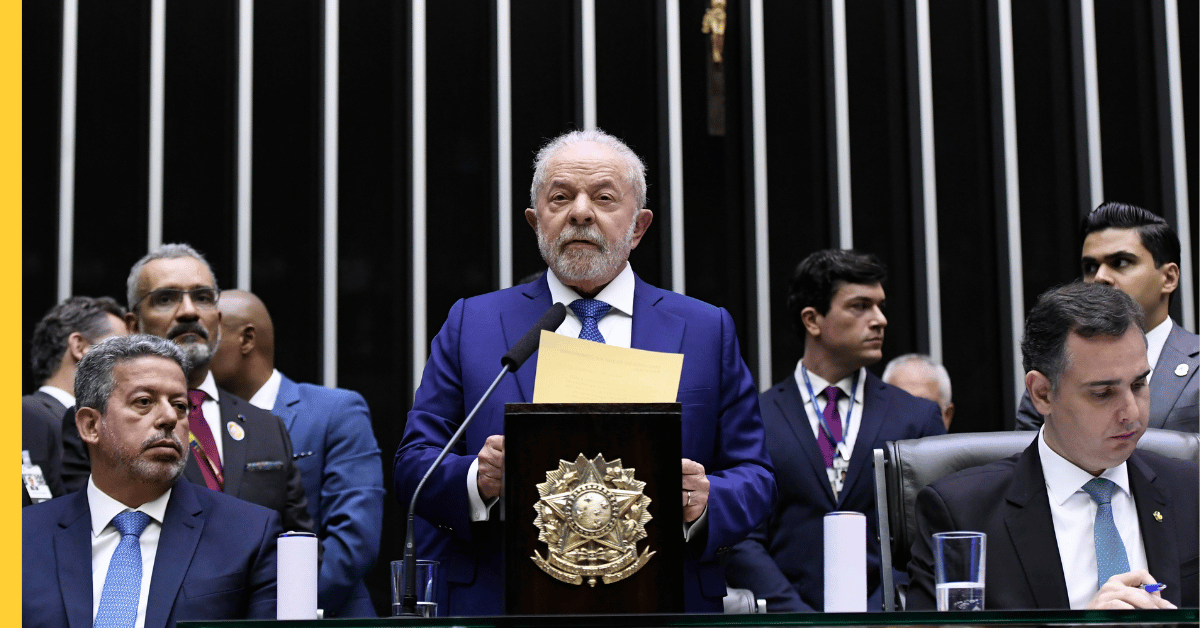
A Provisional Measure to ban gambling in the country is reportedly being prepared by the team of President Luiz Inácio Lula da Silva’s government and could be published in the coming days.
According to information from UOL, the Civil House would be responsible for the text of the provisional measure against bets, which should be sent to Congress soon.
The content of the measure has not yet been defined, although there is an initial directive from Planalto for the complete prohibition of gambling in Brazil.
Industry entities expressed concern about the new developments that the provisional measure could cause. Brazilian football clubs, meanwhile, warn of the risk of R$1 billion in losses.
Election broadens discourse against bets
The proximity of the first round of the 2026 presidential elections, on October 4, and recent concerns about household debt and social problems caused by betting explain the hardening of President Lula’s discourse on the subject.
Throughout this year, Lula stated he was personally against betting houses and, recently, in a meeting with civil, religious, and economic sector entities, he even spoke about a more drastic measure against bets.
Already on the 16th, during his appearance on the Desce a Letra podcast, the president compared addiction to betting with drug addiction, such as crack.
“Remember when crack appeared? The addicted guy would get home and sell the gas canister. Bets are like that. People are selling what they don’t have, getting into debt. And nobody creates gambling to get rich. One person might win while 1 million lose,” he argued.
This more emphatic discourse and the publication of the provisional measure against bets also align with voters’ own perception of betting in the country.
A survey conducted by Meio/Ideia in May of this year already showed that 44% of voters supported banning online gambling, while only 24% believed it should remain in effect.
Lula’s escalation against bets
Lula’s current position contrasts with the actions of his own pro-regulation government in 2023, with the Bets Law, and the start of operations by licensed operators in January 2025.
With the elections and the intensifying clash with the candidate who holds second place in voting intentions, Flávio Bolsonaro, Lula has hardened his discourse against bets.

What if the provisional measure against bets is published?
If the provisional measure against bets is published in the Official Gazette, something that has not yet occurred, it must be forwarded to the National Congress.
Next, a joint committee will be formed to evaluate the provisional measure. Since the validity of the provisional measure is initially 60 consecutive days, if Congress does not complete the vote, the deadline will be extended for another 60 days. There are three possible scenarios:
- Fully approved — The provisional measure against bets becomes law as published;
- Approved with amendments — Text amended by Congress, for example, banning online casinos while maintaining sports betting;
- Rejected — The provisional measure is completely struck down and loses its validity and ongoing effects.
If the text of the provisional measure is approved with amendments, it must return to Planalto for the president’s sanction or veto.
Also considering that if the 120 days for review in Congress run out, the provisional measure against bets would lose its validity.
At the same time, there is a proposal moving through the Chamber, authored by Deputy Paulo Pimenta (PT-RS), to revoke online casino games from Law 14.790 while maintaining fixed-odds sports betting.
Football clubs’ reaction
An imminent provisional measure against bets sparked a reaction from football clubs in Brazil, especially those in Series A and B of the Brazilian Championship.
The official statement, released on the 17th on the social media accounts of teams and entities, was made jointly by the São Paulo Football Federation (FPF) and the Rio de Janeiro State Football Federation (FERJ).
In the text, the clubs acknowledge the negative social impacts of bets, but argue that abrupt changes in legislation will generate legal risks related to contracts already signed under the current regulatory framework.
“An abrupt change in the rules would reduce clubs’ investment capacity and create imbalances both inside and outside the country,” the statement argues.
Currently, 13 of the 20 Série A clubs have a master sponsorship contract with betting companies, totaling an estimated R$ 1 billion in sponsorship revenue.
Industry associations also spoke out about the possible MP (provisional measure) against bets, criticizing the lack of dialogue with the industry, including highlighting the absence of SPA from the discussion, as well as the opening such an initiative would represent for the illegal market.
Industry entities’ positioning
In a statement, the National Association of Games and Lotteries (ANJL) points out that restricting the licensed activity of operators who paid for the 5-year authorization could create grounds for compensation claims.
According to the entity, the impacts generated by compensation claims could reach R$ 120 billion.
Neil Montgomery, founding partner and director of the Montgomery law firm and legal expert in the sector, believes that a possible MP against bets could bring a lot of turbulence, but there is much that can be done.
“Brazil has several B2B operator associations and they can initiate a collective action against an MP in the Supreme Court,” explained Montgomery during the webinar on the Brazil em Foco report, organized by staging-latam.next.io/.
However, he noted that, even though difficult times may be ahead for the sector, a provisional measure against betting does not necessarily mean the end of the industry.
“If the ban is carried out through a provisional measure, it must be taken into account that it needs to be approved by the National Congress. Lula cannot ban bets on his own. He will need the support of Congress,” he pondered.
“Congress approved the laws of 2018 and 2023. I believe that since the regulation protects the consumer and the player, Congress probably won’t support a ban,” concluded Montgomery.