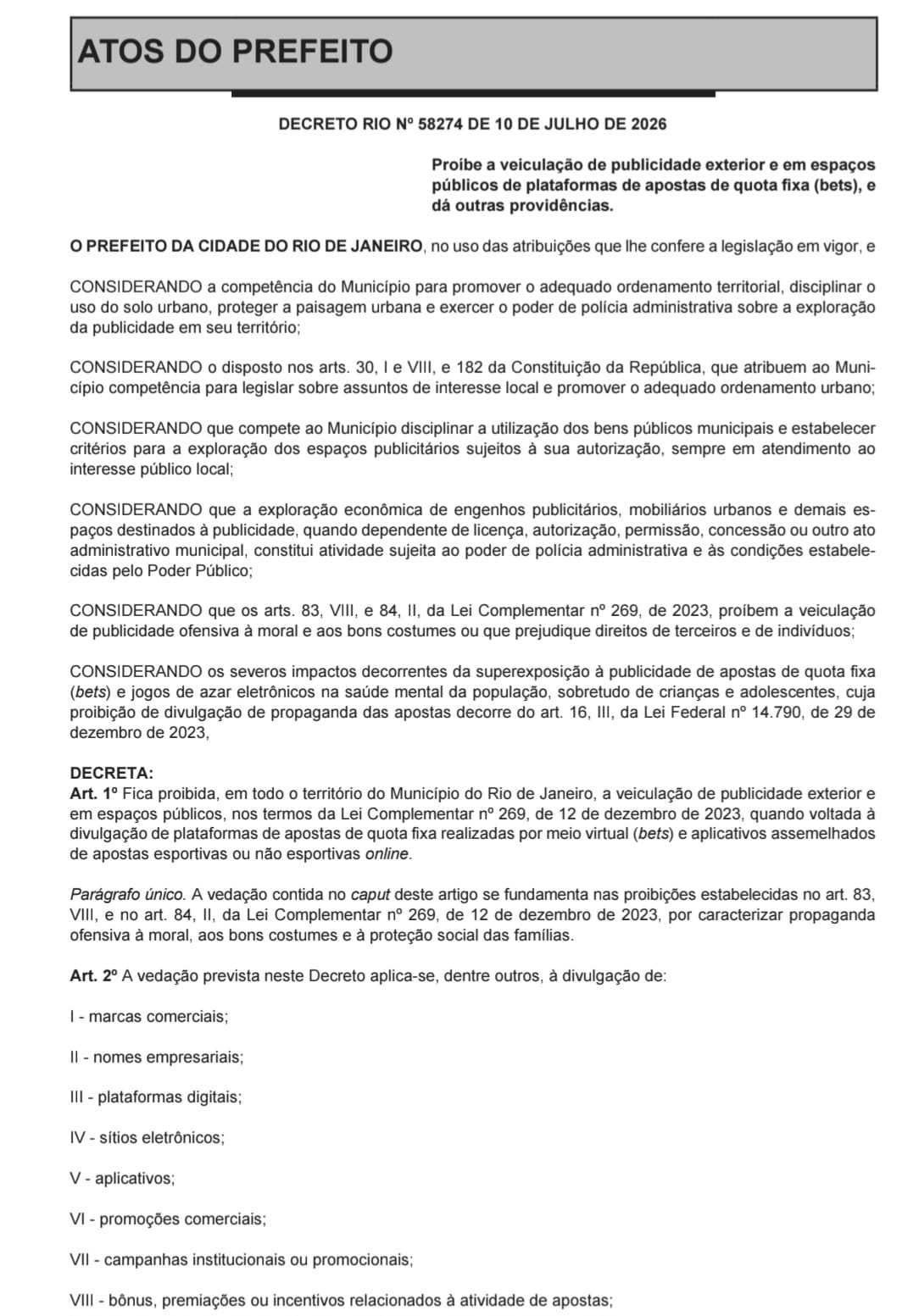
The City of Rio de Janeiro banned, through a decree published this Monday, the 13th, the advertising of betting platforms in public spaces and in locations that require municipal authorization.
The Rio city hall launched this measure, which applies to outdoor advertising, urban furniture, and any location whose use depends on authorization, license, permit, or concession from the city.
Enforcement will be carried out by the Licensing and Inspection Coordination (CLF), which may order the immediate removal of irregular ads.
The rule also applies to new contracts, concessions, and sponsored events, contracted or held by the city.
According to Mayor Eduardo Cavaliere, the goal is to reduce the population’s exposure, especially among children and adolescents, to advertising for sports betting and online gambling.
“Starting today, any outdoor betting advertising is banned on the streets and in public spaces of Rio de Janeiro. Our city, which is the country’s showcase to the world, cannot become an open-air gallery of betting houses, as if that were normal,” said Cavaliere on social media.
Cavaliere compared the effect of betting advertising to that of cigarette ads: “This only proves how advertising has enormous power to influence people’s behavior.”
Awareness in Rio’s schools
The decree adds to two other ongoing initiatives in the city and the state. In the City Council, councilman Cesar Maia (PSD) has already enacted a law requiring public schools to hold at least one bimonthly activity on the risks of betting, including electronic platforms, aimed at students, families, and education professionals.
Maia also presented a proposal for outpatient clinics specializing in gambling addiction and the creation of a Parliamentary Front on the topic.
Alerj
At the state level, the Legislative Assembly of the State of Rio de Janeiro (Alerj) is expected to resume, after the recess, the vote on a bill by state representative Rodrigo Amorim (União) that bans sponsorship and advertising of betting in sports competitions in the state.
The text has already passed through the Constitution and Justice Committee and the first floor discussion, but has not yet been finally approved.
Amorim calls the proposal a “crusade against gambling” and says that the expansion of betting “has caused serious social, financial, and family impacts, as well as favoring illicit practices.”
Reaction
In less than a month, Rio de Janeiro has come to have a municipal restriction already in effect (the advertising decree), a municipal law in effect (the schools one), and a pending state bill, all three targeting the same issue.
For operators that sponsor clubs, stadiums, and events in the city, the decree already requires immediate action on existing contracts; the Alerj bill, if approved, would extend the restriction to the entire state.
The Rio movement runs in parallel with discussions about stricter rules for betting in the National Congress and the Federal Government, a sign that states and municipalities are not waiting for Brasília to act.
For Fellipe Fraga, CBO of Stellar Gamming, the measure requiring schools to carry out awareness activities on the risks of betting is, at first glance, commendable.
“For obvious reasons: anything involving financial resources needs to be done with awareness, and that includes entertainment as well. Future adults, having been taught this way, will have better analytical capacity to know if and how much they can bet,” he says.
“However, the only concern is about the content: how it will be taught, what tone of voice will be used, whether the difference with the illegal market will be clarified, whether it will not unduly vilify the regulated sector, and especially whether the sector will be invited to participate to contribute. In any case, if well executed, the model could be replicated in other institutions.”
The National Association of Games and Lotteries (ANJL), while respecting the autonomy of states and municipalities, said it will adopt appropriate measures to ensure compliance with federal regulations governing advertising in the sector.
The ANJL argues that the Rio decree stands out for not being accompanied by measures against illegal gambling, while the regulated market, which pays taxes and employs thousands of people, is the target of the restriction.
The association states that it is available to federal authorities, Congress, and civil society to discuss the regulation of the sector, and reinforces its commitment to responsible advertising, arguing that any restrictions should be handled by the federal government.
In case of non-compliance with the new rule, “offenders, including exhibiting companies and advertisers,” may be punished with fines, as well as “the immediate revocation or annulment of advertising authorization, the determination of immediate removal of the irregular advertising device, and other measures provided for in applicable legislation.”
See the decree