
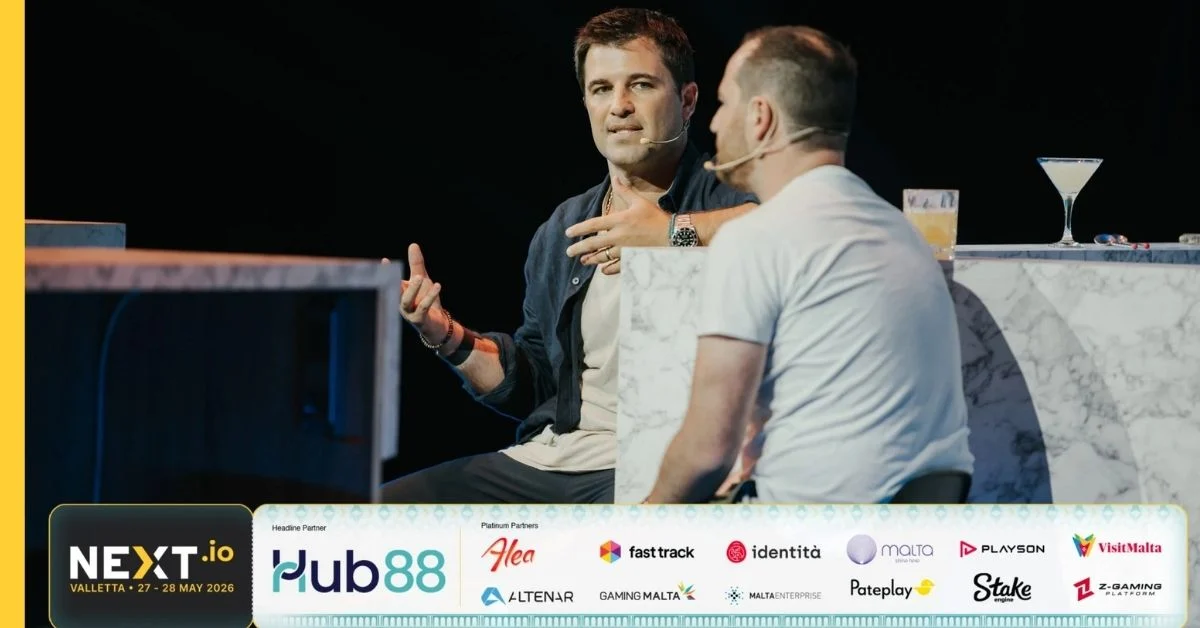
When asked which current industry trends he would like to eliminate, David Carruthers didn’t hesitate: “prediction markets. They shouldn’t be allowed until they are certified as bets, which, after all, is what they are.”
“This isn’t some kind of financial sophistication reserved for wealthy, educated people. It’s just a bet. And a bet is a bet,” Carruthers stated.
For his part, Jesper Kärrbrink added with humor: “If it walks like a duck, swims like a duck, and quacks like a duck, then it’s a damn duck. I totally agree.”
Heated debate
The conversation around prediction markets dominated the agenda at Next Summit Valletta 2026 last week. And it reached its hottest point in a panel discussion featuring Christopher Dalli, CEO of L&L Europe, and Noah Traisman, CEO of Winible (pictured).
The dialogue revolved not only around prediction markets but also around cultural clashes and business perspectives. Dalli threw the first punch: “Prediction markets? We call that sports betting. When are they going to stop using that term?” Dalli’s strongest argument centered on the notion that these platforms function as a peer-to-peer market (peer-to-peer).
According to the L&L Europe CEO, consumers aren’t aware that they’re often operating against professional market makers who, in many cases, are affiliated with the platform itself. “In reality, they’re betting against the house, not against each other. But we tell them it’s peer-to-peer.”
For his part, Traisman staunchly defended prediction markets and took aim at the DraftKings and FanDuel duopoly in the sports betting space. He noted that the gaming giants have built their businesses on a model that floods losing players with bonuses while punishing winners. “They limit you once they realize you’ve found an edge,” he said.
He also argued that the traditional sports betting industry is in no position to lecture from a moral pedestal.
Is there a bubble?
Away from the stages, the talk centered on possible signs of a bubble.
A well-known American investor, speaking privately, was categorical: there’s a wave of hysteria surrounding prediction markets today, and something similar to what was experienced with sports betting in 2021 is happening now.
The figures attributed to Kalshi and Polymarket don’t reflect reality. He went even further, stating that, within three years, prediction markets as we know them will cease to exist. And that, in particular, sports markets won’t be able to survive the regulatory adjustment that is coming.
It’s likely that the Supreme Court will be the one to decide whether these platforms are betting products or financial instruments.
Regardless of the outcome, Traisman stated: “If I had to make a bet on who is going to make changes to prioritize customer interests over the next three to five years, I’d bet everything on prediction markets.”