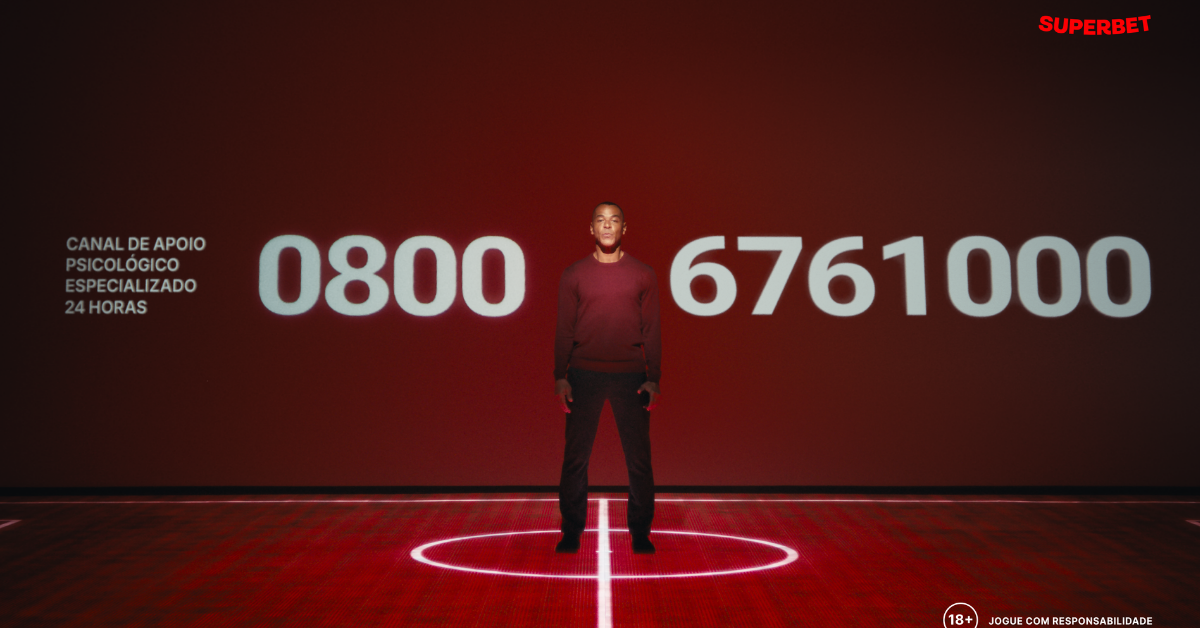
The Linha Super, a channel for players available 24 hours a day by phone and WhatsApp, is operated in partnership with the Instituto de Proteção ao Jogador (IPJ) and expands remote support capacity to up to 3,500 people per month, according to demand.
Two months after the “Block no Tigrinho” movement brought together major names in Brazilian music and culture to demand tougher rules against betting advertising, and after the Senate’s Science and Technology Committee approved Bill 3.563/2024, Superbet announced this Monday (31) one of the largest investments in responsible gambling ever made by an operator in the country.
The Linha Super is a support channel for players with gambling problems, available 24 hours a day, by phone or WhatsApp, which will expand its remote support capacity to up to 3,500 people per month, and could increase further, as Superbet explained, according to demand.
Support is provided by social workers, psychologists, and psychiatrists, and is open to anyone who needs help, whether or not they are a customer of the platform.
In a LinkedIn post, Thomas Carvalhaes, co-founder of SCCG Brazil, commented on the launch: “It’s the basics done well! Something relatively simple to do, but that makes a huge difference, across all spheres of society.”
Scale of the investment
The launch is backed by a R$60 million advertising campaign starring former national team player Cafu, debuting with a commercial during Globo’s 7 p.m. soap opera.
At that time slot, each 30-second spot costs around R$600,000, according to the network’s price table.
It is the second-largest media investment in Superbet’s history, behind only the campaign aired during the World Cup, also on Globo.
CEO Alexandre Fonseca says he still cannot pinpoint the total cost of the initiative: according to him, the main expense lies in sustaining the scale of support, which can range from 1,000 to 10,000 people per month depending on demand.
The company states that it will use its entire media structure, TV, social media, sponsored clubs, stadium LED boards, to promote the service, and that the initiative is not aimed at acquiring new users or capitalizing on the brand.
The argument against restrictions on the industry
Faced with the debate over how to address the effects of betting on society, Fonseca argues that the problem lies in consumer education, an area in which he considers the company an expert, rather than in restrictive measures.
Regarding a possible additional tax, he argues it would change nothing for the end consumer: unlike what happens with alcoholic beverages, the prizes paid out would remain the same, and it would be the companies themselves that would lose investment capacity.
Regarding a possible ban on online betting, he says he doesn’t see that happening and argues it would create the largest illegal market in the world, pushing underground an estimated R$50 billion to R$60 billion in annual revenue, in 2025, Brazil was the third country with the highest betting revenue in the world, behind only the US and England.
A former Betano director responsible for negotiating the naming rights of the Brazilian Championship, Fonseca sees widespread advertising as the only competitive advantage a regulated betting company has over illegal operations, an argument he uses against proposals to restrict advertising in the sector.
He also points to room for the market to grow: betting penetration in Brazil stands at around 10% of the population, according to the Ministry of Finance, compared to 25% in the United Kingdom.

The numbers behind the pressure
The 2025 National Survey on Alcohol and Drugs estimates that 1.4 million Brazilians (0.8% of the population) have a condition consistent with Gambling Disorder.
According to psychiatrist Rodrigo Machado, of Hospital das Clínicas, Brazil’s problem is the rate of players at risk of developing the disorder, above 7%, compared to between 1% and 3% in other countries, a number that tends to rise as the effects of recent regulation mature.
The most frequent comparison is with Norway, where the rate of affected players fell from 1.4% in 2019 to 0.6% in 2022 after the government created a state duopoly and banned advertising by foreign private operators.
Fonseca notes that the parallel has its limits: Norway starts from a much higher baseline of financial education, income, and public service networks.
Contact with the Linha Super in Brazil can be made at 0800 676 1000 or via WhatsApp.