

More than 1.2 million Brazilians have voluntarily requested self-exclusion from licensed betting platforms since December 2025, according to data obtained via the Access to Information Law.
This number already surpasses several self-exclusion records established abroad, some of which have been in operation for nearly a decade.
The Secretariat of Prizes and Bets (SPA), under the Ministry of Finance, confirmed 1,214,252 registrations in the Centralized Self-Exclusion Platform as of August 2026, equivalent to 3% of the 40 million active CPFs registered in Sigap, the national betting management system.
The numbers were obtained by the BNL Data portal via the Access to Information Law and independently confirmed by Agência Gov, which recorded “more than 1.2 million requests” as of the same reference date.
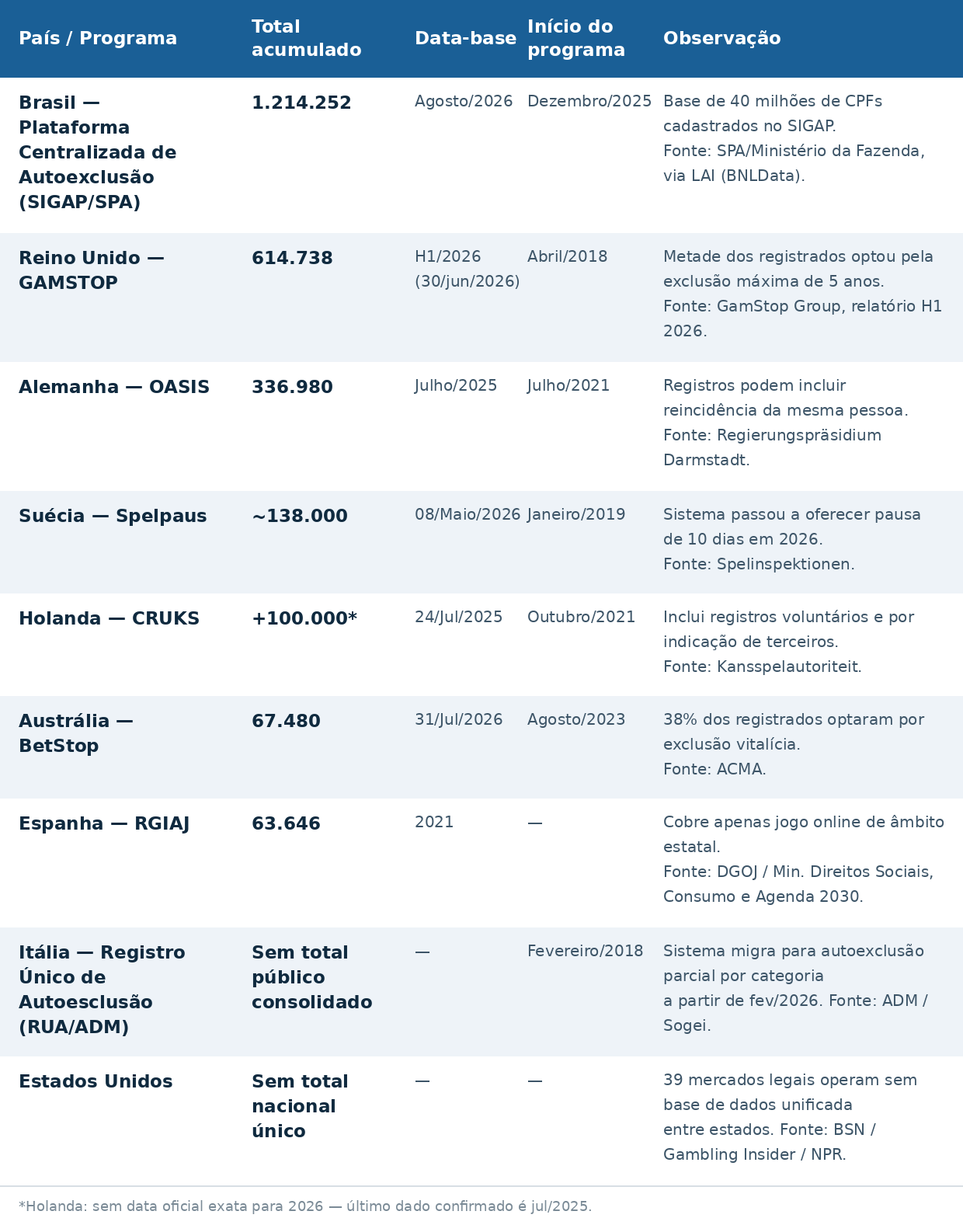
By comparison, the United Kingdom’s system has been operating for eight years (since April 2018), Germany’s for four years, and Sweden’s for more than seven years, yet all of them still accumulate lower absolute volumes than Brazil’s, which reached this mark in less than a year of operation (since December 2025).
However, the calculation criteria and coverage vary between countries (see caveat below).
Two-thirds of self-exclusions in Brazil, 811,590 people according to BNL, or 66.95% according to Agência Gov, opted for an indefinite period rather than a fixed pause.
As for the stated reason, SPA data shows a divided scenario: about half indicated reasons pointing to an already established problem, loss of control over gambling, financial difficulties, or a professional health recommendation, while the other half used the tool by voluntary decision, as a precaution regarding the use of their own data by operators, or chose not to state a reason.
A caveat about the comparison
The numbers are not directly comparable to one another. The German system may count multiple registrations from the same person. The Brazilian percentage is calculated based on active bettors in Sigap, while the United Kingdom, Sweden, and the Netherlands typically report the share relative to the total adult population, a broader base that produces lower percentages by definition.
Coverage also varies: Spain’s RGIAJ, with 63,646 registrations in 2021 (the most recent year with an official update, according to the DGOJ), covers only state-level online gambling, while Brazil’s and Australia’s registrations apply to the entire licensed platform.
In Italy, the RUA system does not publish a consolidated national total. In the United States, 39 states operate legal betting markets without a shared self-exclusion database, a person excluded in one state can still register in another.
The illegal market gap
Since it began asking, during telehealth calls, whether the platform used by the patient is authorized by SPA/MF, the Ministry of Health recorded only 291 responses between February 25 and August 27, 2026, a small sample given the service’s capacity, which reaches up to 100,000 telehealth calls per month.
Even so, among those who responded, bettors on illegal sites (37.5%) already outnumber those on the authorized market (34.0%), despite the licensed market concentrating the vast majority of betting volume in the country.
Self-exclusion, deposit blocking, and CPF-based tracking exist only in the regulated market.
Unlicensed platforms have no equivalent obligation, and their treatment costs fall on the SUS (Brazil’s public health system) all the same.