The Federal Public Prosecutor’s Office and the Federal Revenue Service launched Operation Jogo de Sombras (Shadow Game) against the NSX group, owner of Betnacional and a subsidiary of Flutter, on suspicion of money laundering, tax evasion, and illegal foreign exchange transactions before and after the 2025 regulation.
According to the Federal Public Prosecutor’s Office, which is leading the investigation through Gaeco (Special Action Group for Combating Organized Crime), the platform moved more than R$5 billion in 2025. The operation resulted in the freezing of R$191 million in assets.
Betnacional ranks among the top ten betting houses in Brazil, according to data from the consultancy H2 Gambling Capital.
The company is controlled by NSX and has Flutter, an Irish multinational listed on the New York Stock Exchange, as its majority shareholder: the company paid R$2 billion for 56% of the business. So far, Flutter has not publicly commented on the operation.
According to the Federal Public Prosecutor’s Office, the alleged tax and financial irregularities are said to have occurred both before and after the fixed-odds betting sector regulation took effect in Brazil in 2025.
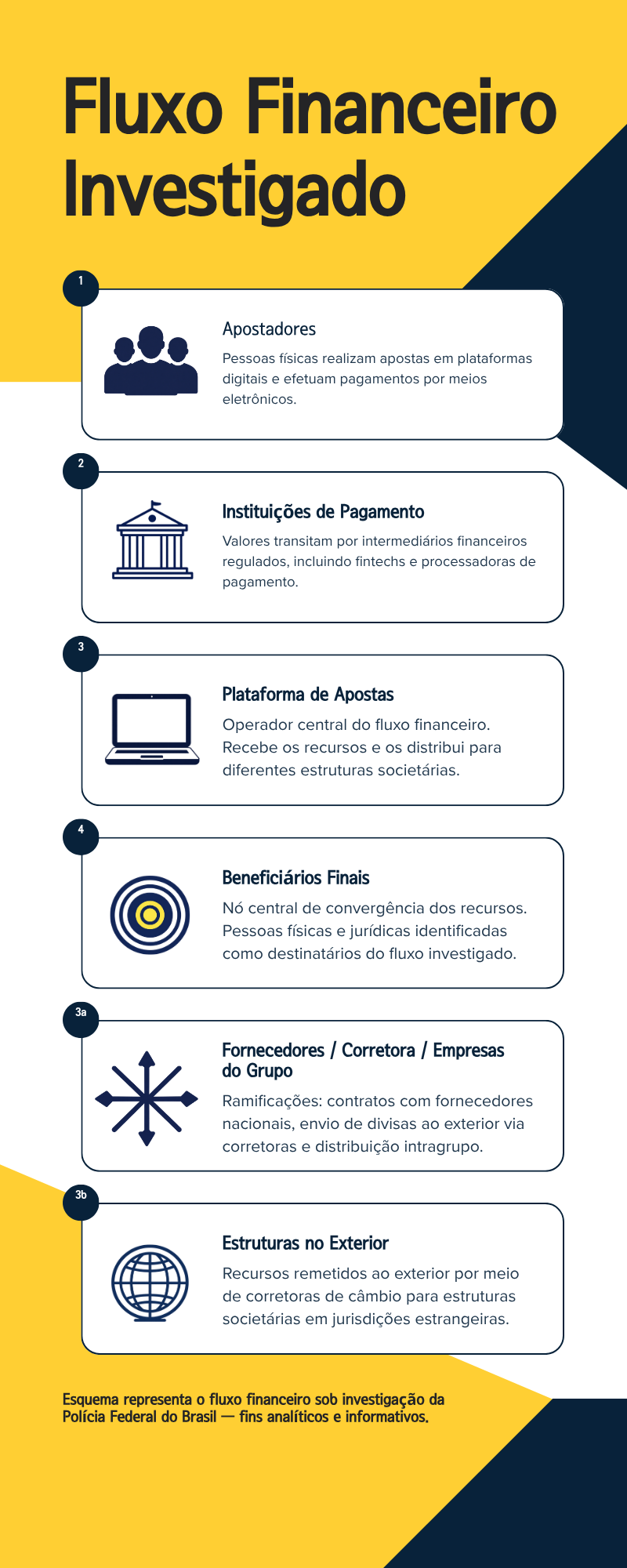
The Federal Revenue Service states that those under investigation allegedly created a shell company in Curaçao to make it appear that the platform’s operations took place outside the country, while national companies linked to the group were actually responsible for the activity on Brazilian soil.
According to the Revenue Service, indications were found of accounts held at fintechs with the purpose of making it harder to trace financial transactions and identify the final beneficiaries of the funds.
The agency estimates a potential recovery of around R$300 million for public coffers and has opened 11 additional tax proceedings to further the investigation.
The Federal Revenue Service secretary, Robinson Barreirinhas, stated that the company allegedly operated illegally in the betting sector in Brazil and that there are indications the irregularities continued even after regulation.
Despite the investigation, Betnacional remains authorized to operate.
The secretary of Prizes and Betting at the Ministry of Finance, Daniele Cardoso, stated that the platform is already facing two sanctioning proceedings, which could result in the suspension of its activities, and that the department is awaiting the sharing of evidence by the Judiciary in order to proceed with the analysis of the case.
NSX’s response
In a statement, NSX Brasil confirmed it had received an inspection visit from the Federal Revenue Service at its Recife office, but stated that its lawyers had not yet had access to the investigation files and, therefore, could not comment on the content of the inquiries.
However, it also stated: “The company provided full cooperation with the action, making the requested documents available, and will remain at the disposal of the authorities for any clarifications that may be necessary.
Before the specific regulation of the betting sector, the company operated in accordance with the legal framework in force at the time and with the practices adopted by the market during that period.
“After the new regulation took effect, it made the necessary adjustments and began to rigorously comply with the rules applicable to operating in the Brazilian market.
The company remains committed to transparency, respect for institutions, and strict compliance with its obligations, trusting that the necessary clarifications will be provided through the appropriate institutional channels.”
Patterns repeat
The case follows a pattern similar to other recent operations against major betting companies in the regulated market.
Before 2025, it was common for operators such as Betnacional and Pixbet, also a target of a Revenue Service investigation, to operate with licenses issued in tax havens such as Malta and Curaçao, a requirement that forced deposits to be processed outside of Brazil.
According to Leonardo Baptista, CEO of Pay4Fun, it was common for Brazilian payment institutions to send deposits to offshore companies through foreign exchange transactions or stablecoins, cryptocurrencies with a value pegged to the dollar.
According to him, the problematic point during the period under investigation was in how operators and payment institutions withdrew profits and paid local suppliers, including marketing contracts, through companies based abroad.
In this first phase, Operation Jogo de Sombras targeted only the NSX group, without including suppliers as targets, unlike Aposta Suja/Operação Arena, which also reached service providers linked to Pixbet.