
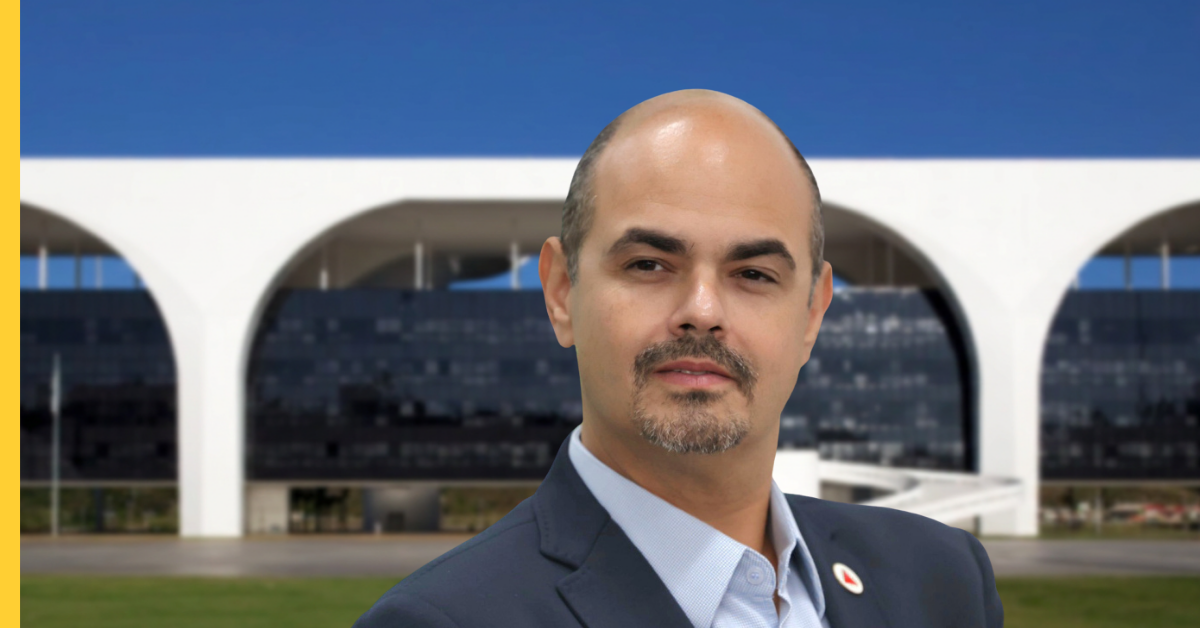
Minas Gerais bans betting advertising on state-owned property and public stadiums, including Mineirão, following the trend started by Rio de Janeiro and Belo Horizonte, but raising the restriction from the municipal level to the state level.
The decree, signed by Governor Mateus Simões (PSD), who is running for re-election, took effect this Thursday (8/20).
The measure bans betting companies’ advertising on state-owned property and public roads, as well as in stadiums granted to private enterprise by the Minas Gerais government, which includes Mineirão, home to Cruzeiro’s matches in the Brazilian Championship, and Mineirinho, an arena that hosts volleyball matches and other sports.
According to the governor, the ban applies to any form of advertising display in these spaces, which includes the boards around the pitch during matches, even with the Brazilian Championship currently having Betano as a sponsor.
Asked about the possibility of Mineirão keeping the ads during Cruzeiro’s matches, Simões stated that the government will go to court if the concessionaire attempts to keep the advertising, since the venue belongs to the State.
Contacted by Estadão‘s reporting team, the concessionaire responsible for managing Mineirão stated that it was not yet aware of the measure.
Cruzeiro did not comment. Brax Sports Assets, the company that holds the commercialization rights for the club’s advertising boards, also did not respond, nor did the Brazilian Football Confederation (CBF), organizer of the Brazilian Championship.
Part of a larger package
The restriction in stadiums is just one of the measures announced by the Minas Gerais government to curb the advance of betting in the state.
The Loteria Mineira received notice to immediately terminate the Lotominas.Bet contract, and the government plans to send a draft decree to the state’s 853 city halls suggesting that municipalities also ban betting advertising on local public facilities, a recommendation rather than an obligation.
The revenue argument
Simões justified the decree by citing state revenue: ICMS tax revenue in Minas Gerais grew, in the first half of 2026, only in line with inflation, below the expected 2% real growth.
For the governor, the difference is linked to household spending on betting, although he acknowledges that other factors, such as debt, also play a role. Simões also cited the risk of addiction as another motivation for the restrictions.
This interpretation is the governor’s own reading, not causal data proven by a technical study.
A trend that already started in the capital cities
Rio de Janeiro was a pioneer in banning betting advertising in municipal public spaces; Belo Horizonte followed suit, and similar proposals are underway in São Paulo and Recife.
The Minas Gerais distinction: for the first time, the restriction stops being municipal and starts applying to an entire state.
Combined with the recent tightening of federal advertising rules, which already prohibit presenting betting as easy income or investment, the measure leaves operators navigating three simultaneous layers of restriction: federal, state, and municipal.
The industry’s reaction
In a statement, the Brazilian Institute of Responsible Gaming (IBJR) said it is following the discussions on advertising restrictions and advocates for the debate to take place on a technical basis, with dialogue between public authorities and the regulated sector, seeking to improve consumer protection rules.
The National Association of Games and Lotteries (ANJL), in turn, announced that it will file a Direct Action of Unconstitutionality (ADI) with the Federal Supreme Court (STF) against the Minas Gerais Government’s decree that restricts advertising, promotion, and promotional actions by fixed-odds betting companies on state-owned property and public spaces.
For the ANJL, “the discussion in Minas Gerais relates to the same principle: the need to preserve federal authority to regulate the fixed-odds betting market and ensure uniformity, predictability, and legal certainty for operators authorized throughout the country,” the organization stated.