
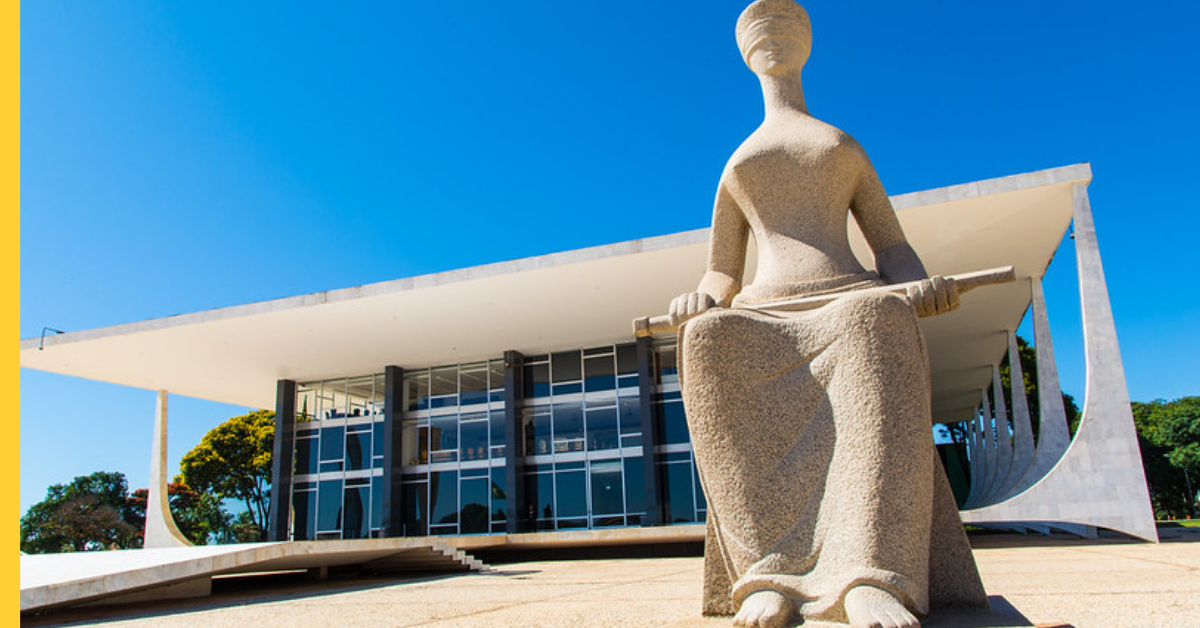
During the ruling on Extraordinary Appeal (RE) 966177 at the STF, Justice Luiz Fux defended keeping gambling criminalized in Brazil. The session took place at the Federal Supreme Court this Wednesday, August 5th.
Fux, who is also the rapporteur of the case, stated in the introduction of his vote that bets, gambling, bingo, and slot machines capture people through a new “deleterious marketing strategy.”
The debate was closed, but should resume this Thursday, and will conclude a case that has been pending for ten years at the Court, in which Article 50 of the Law on Criminal Misdemeanors determines the prohibition of gambling exploitation.
Main arguments
At the opening of the ruling on the criminalization of gambling, the prosecutor of the Public Prosecutor’s Office of Rio Grande do Sul, Flávia Raphael Mallmann, stated that Article 50 of the 1941 Law on Criminal Misdemeanors was upheld by the 1988 Federal Constitution.
For her, continuing to consider gambling a crime “remains necessary given the close link between the clandestine exploitation of gambling and other forms of criminality.”
Next, the defense lawyer, Laerte Luis Gschwenter, argued that “there is no technical, legal, or empirical distinction that justifies considering the territorial and physical operation of any bingo a crime.”
Gschwenter also argued that the State does not have the legitimacy to determine that conduct within the scope of an individual citizen’s choice is a crime, as an argument for the decriminalization of gambling.
However, as Fux maintained in the introduction of his vote, “there is nothing in the Constitution that would allow one to conclude that the Constitution did not uphold gambling.”
The justice also added that it is a contradiction to speak of freedom of enterprise when it comes to the economic activity of gambling.
For him, the most relevant point in the discussion about keeping gambling criminalized would be protecting the legal interest of greatest value, in this case, society, from the harmful impacts of gambling, including the use of funds for money laundering and trafficking.
Pressure should increase in the Senate
Regardless of the STF’s decision on keeping gambling criminalized, and consequently casinos, bingo, and the jogo do bicho, the debate on the topic does not end here.
This is because allowing the operation of gambling in public venues depends on the National Congress and the Executive branch.
In the Federal Senate, Bill 2,234/2022 aims to authorize the operation of casinos, bingo, the jogo do bicho, and betting on horse races (turf).
There are specific rules indicated in the bill, such as limiting the installation of physical casinos to integrated leisure complexes and resorts, or vessels.
The bill also determines that each state may have at most one casino, with the exception of São Paulo, which may have 3, and Minas Gerais, Rio de Janeiro, Amazonas, and Pará (up to 2 for each state).
Although it has been ready for a floor vote since December 2024, there is still no date for this to happen.
Recalling Extraordinary Appeal (RE) 966177
The case that gave rise to RE 966177 arose after a 2015 ruling by the Rio Grande do Sul judiciary, which found that Article 50 of the Law on Criminal Misdemeanors had not been upheld by the Constitution.
In turn, the Public Prosecutor’s Office appealed the ruling to the STF. The Supreme Court recognized the national relevance of the discussion and, as a result, the case was granted general repercussion status.
