
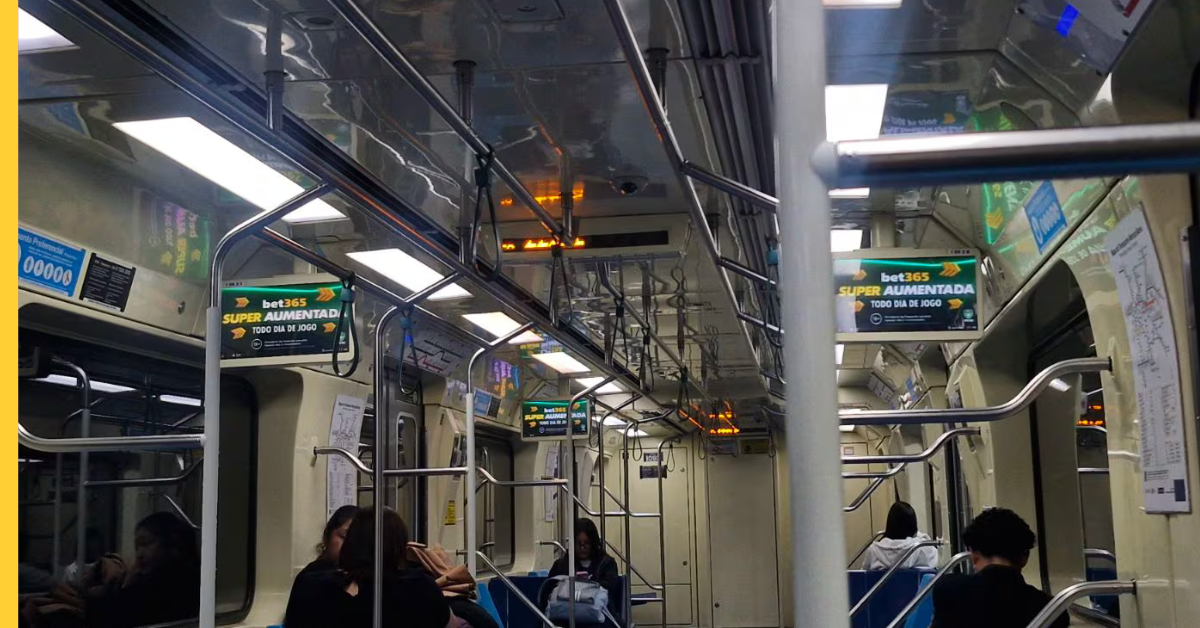
A report by Estadão mapped 20 betting advertising spots along Avenida Paulista, with ads displayed every 60 seconds, on average, on digital billboards.
The survey, conducted on July 17 and 30, 2026 using a proprietary geolocation platform (accuracy between 5 and 10 meters), identified campaigns from four operators (bet365, BetMGM, Betano and Superbet) at bus shelters, digital clocks, billboards and São Paulo Metro cars (Lines 2-Green and 3-Red).
The interval varied according to the equipment: between 30 and 90 seconds at bus stops, and 70 to 90 seconds on digital clocks.
The four companies are among the 100 biggest advertisers in the country in 2025, according to data from Ibope-Advertising Intelligence cited by Estadão: Betano (17th, R$ 616 million), BetMGM (37th, R$ 365 million), Superbet (51st, R$ 265 million) and bet365 (53rd, R$ 260 million).

Concessions and outdoor media
The spaces are public, but operated by private concessionaires. JCDecaux Brasil manages advertising on a thousand digital clocks until 2038 and on Metro Lines 1, 2, 3 and 15 until 2036.
Eletromidia, through Otima, controls billboards and bus shelters (6,500 units, with 7,500 expected by 2042) and also has spaces in the São Paulo Metro.
According to Estadão, the OOH media sector raised R$ 827 million between January and March 2026, 14.8% of the national advertising market, behind only TV and internet.
Municipal regulation not yet defined
Currently there is no ban on campaigns in São Paulo. The Secretariat of Prizes and Bets (SPA/MF) prohibits ads in places intended for minors, but the report points out a gap: bus shelters have no way to filter the audience exposed.
According to the São Paulo City Hall, the campaigns follow the legislation and the concession contracts, with no interference by the municipality in advertising sales.
The São Paulo Metro states there is no rule banning ads from the sector on its premises.
The scenario contrasts with Rio de Janeiro, Campinas and Belo Horizonte, where betting advertising in public spaces is already banned.
Possible change in August
According to Estadão, Mayor Ricardo Nunes (MDB) committed to signing Bill 560/2025, by councilman João Jorge (MDB), which will be processed together with Bill 553/2025 (Adrilles Jorge, União Brasil).
The original text restricted ads at sporting events, but the councilman broadened the scope to ban betting advertising in any municipal public space, inspired by the Rio de Janeiro ban.
The bill is expected to move forward when the City Council resumes activities in August.
The SPA stated that any municipal rules must respect the constitutional division of powers among federative entities, without prejudice to the Union’s responsibilities.
Beatriz Gimenez Costa, vice-president of the Gaming, Betting and Responsible Gambling Law Commission of OAB-SP, says the regulated Brazilian market is still recent and coexists with the presence of illegal operators, so it would be necessary to observe market practice before making further regulatory adjustments.
According to her, “advertising will be extremely important for consumers to bet safely”.
Betting operators’ position
The Brazilian Institute of Responsible Gaming (IBJR), which represents bet365, BetMGM and Betano, said it is following the municipal discussions and advocates technical dialogue between public authorities and the regulated sector.
Superbet told Estadão that it reinforces the relevance of OOH media at the current moment of consolidation of the regulated market and affirmed its commitment to transparent operation aligned with Brazilian authorities.
Regulation on betting advertising in public spaces currently varies among municipalities: Rio de Janeiro, Campinas and Belo Horizonte already ban the ads. Recife and Aracaju have bills in progress, while São Paulo still has no ban in effect.
This is expected to change with the progress of Bill 560/2025, which extends the ban to any municipal public space and awaits Mayor Ricardo Nunes’s signature after the City Council resumes activities in August.