
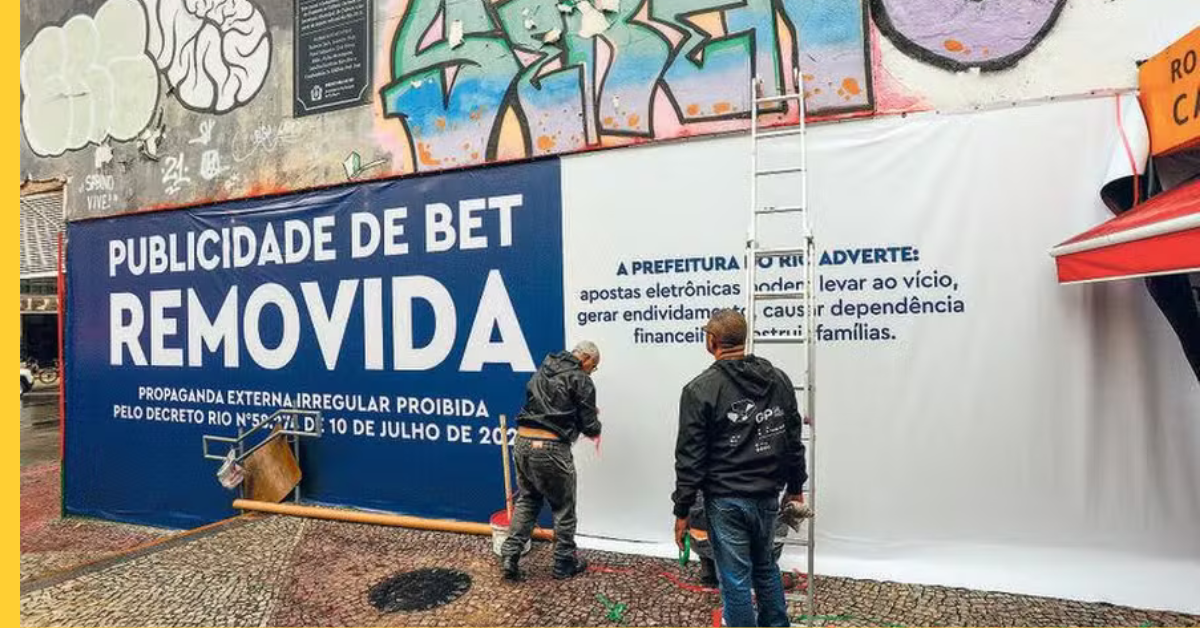
Following Rio’s example, São Paulo, Belo Horizonte, Aracaju and Recife join the initiative.
The ban on betting advertising in public spaces, decreed by Rio de Janeiro on July 13, has spread to other capitals. São Paulo, Belo Horizonte, Aracaju and Recife are in the process of adopting similar measures.
São Paulo
The mayor of São Paulo, Ricardo Nunes (MDB), has committed to signing a bill by councilman João Jorge (MDB), introduced in 2025.
The original text limited the ban to advertising at sporting events. After the Rio decree, João Jorge decided to broaden the scope to include any public space, and will present a substitute bill to that effect.
The bill is moving forward alongside a proposal by councilman Adrilles Jorge (União Brasil), which bans advertising at municipal public agency events, bus stops, digital clocks, public transit, and municipal sports arenas. The vote is scheduled for the first week after the legislative recess, in August.
Belo Horizonte
The Belo Horizonte city government issued a decree on July 14 banning betting advertising on municipal properties (schools, hospitals, parks, libraries, sports facilities) and on street furniture, including park benches, bus shelters, and information kiosks.
The measure also applies to concessions and permits operated by private companies, and to events promoted by the city government.
The ban extends to a 100-meter radius around schools, museums, and facilities aimed at children and adolescents. Municipal agencies have 15 business days to review existing contracts.
Recife
Councilwoman Jô Cavalcanti (PSOL) introduced a similar bill, with a 200-meter ban radius around schools, the widest among all the cities.
The bill is under review by the City Council. The city government stated that it “will adopt restrictive measures” and that it has forwarded the matter for technical and legal analysis.
Aracaju
The Aracaju city government published, on Thursday (16th), Decree No. 8,740, which is not limited to traditional ads.
It bans any form of betting promotion, including by brand, app, website, or logo, across any medium or technology. It is a more detailed text than those of BH and RJ, which address advertising on properties and street furniture in a more generic way.
What changes in each city
In Rio de Janeiro, the ban is already in effect and is total, covering public spaces and sites under municipal authorization.
In Belo Horizonte, also already in effect, the restriction applies to municipal properties and street furniture, with a 100-meter radius around schools.
In São Paulo, the bill has not yet been signed into law, but had its scope expanded after the Rio measure, with a vote expected in August. And in Recife, the bill is under review, with a 200-meter ban radius and no set date for a vote.
Aracaju has the most textually detailed ban (covering brands, apps, sponsorship, any technology), with named enforcement and a transition period, but it is the only one, among those mentioned, without a distance-radius criterion from schools.
Sector reaction
The National Association of Games and Lotteries (ANJL) disagrees with the municipal measures. According to lawyer Bernardo Cavalcanti Freire, the association’s legal representative, the bans are unconstitutional because they discriminate against an economic sector, and the position of the city governments is “political, not technical” — a claim made by the association, not a court ruling so far.
He also stated that Rio de Janeiro’s decree is even more concerning because the city has not taken any action to curb illegal gambling.
“A regulated market, which pays taxes and generates thousands of jobs, is the target of an unfounded attack.”
Cavalcanti Freire argues that the regulated sector is being targeted with restrictions without equivalent measures against illegal gambling.
From a consumer protection standpoint, Cristiano Costa, a psychologist at the Brazilian Support Company for Compulsive Behavior (EBAC), believes the new guidelines strengthen the informational role of advertising.
“Advertising should inform, not create unrealistic expectations. Messages that stimulate urgency or associate betting with financial security can distort consumer perception. By establishing limits for this type of communication, the regulation contributes to a more conscious relationship between the bettor and the activity, preserving the recreational nature of betting,” he/she observes.
Diego Bittencourt, COO & Partner at Start Bet, opines: “Every consumer protection initiative deserves to be discussed, but it is necessary to differentiate regulated companies from illegal platforms.”
“Authorized operators follow strict rules on advertising, responsible gaming, and fraud prevention; broadly restricting their communication reduces the visibility of those operating within the law, while irregular operators continue to find ways to reach the public.”
“As a company born in Minas Gerais that operates within Brazilian regulation, we understand that any local measure needs to consider its impact on those who invest in compliance, job creation, and tax revenue, without losing sight of the fact that the main challenge remains combating illegal platforms, which operate outside any oversight,” he/she concludes.
The Brazilian Institute of Responsible Gaming (IBJR) stated that it will not comment on the municipal bans.
Federal parallel
The municipal movement occurs in parallel with federal government ordinances, which take effect on July 17. The new rules prohibit presenting betting as a source of income, investment, or easy money, and ban sports analyses aimed at inducing bets.
At the state level, the Rio de Janeiro Legislative Assembly is expected to resume, after the recess, the vote on a bill by state representative Rodrigo Amorim (União), which prohibits sponsorship and advertising of betting in sporting competitions in the state.
The text has already passed through the Constitution and Justice Committee, but has not yet been fully approved.