

The Senate’s Science and Technology Committee (CCT) held a public hearing this Tuesday, the 1st, on Bill 2,470/2026, which addresses the protection of mental health, consumers, and family finances in the environment of fixed-odds betting and online gambling in Brazil.
Authored by Senator Damares Alves (Republicanos-DF), the bill focuses on prevention and harm reduction, restricting advertising, sponsorship, and the design of high-risk betting products, in addition to proposing a risk classification system for different types of betting products.
The rapporteur, Senator Alessandro Vieira (MDB-SE), said he expects to present a first version of the report as early as Wednesday, calling the vote urgent, although he acknowledged there are still points to be debated.
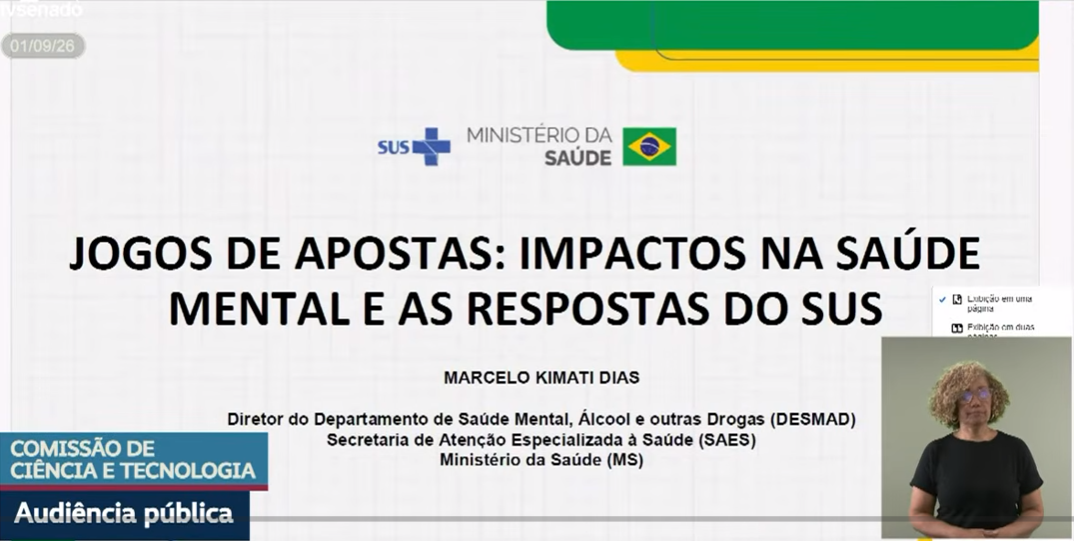
The representative of the Ministry of Health, Marcelo Kimati Dias, stated that around 25 million Brazilians placed bets on legalized platforms last year, and that care provided by the public health system related to betting problems grew 140% between 2018 and 2025.
According to him, people with betting problems have a suicide risk up to 15 times higher than the general population, and the affected profile is mostly young, Black, low-income, and concentrated in the Northeast region.
Dias also pointed out that only 1% of the revenue collected from bets is passed on to the Ministry of Health.
A study by the Pan American Health Organization (PAHO), cited by national consultant Francisco Cordeiro, found that for every real collected by the government from bets, the country spends about four reais to deal with the associated social cost.
The Director of Consumer Protection at the Ministry of Justice, Daniel Amaral Nunes Carnaúba, advocated for strengthening regulation of the sector, stating that his department investigates irregular advertising, digital influencers, and companies linked to the illegal betting market.
He questioned the cost of bets’ role as the main sponsors of sporting events, citing family debt, suicides, and loss of assets.
Sector representative
Representing the sector, the CEO of IBJR, Carlos Eduardo Cabral Lima, cited a study by Aliciar Consultoria according to which Brazilian family debt stems more from cell phone purchases, streaming subscriptions, and alcohol consumption than from betting, which, according to him, ranked last in the survey.
Lima stated that the regulated sector generates R$ 9.6 billion in revenue and more than 15,500 direct and indirect jobs, with gross revenue of R$ 35 billion, and argued that the sector’s main challenge is competing with illegal platforms.
He highlighted that licensed operators offer identity verification, betting limits, and consumer protection tools that are nonexistent on unlicensed sites.
On the government’s side, the representative of the Ministry of Finance, Andiara Maria Braga Maranhão, stated that the Centralized Self-Exclusion Platform, launched in December, has already been used by more than one million people to block their own access to licensed betting sites.
She added that current legislation already prohibits minors from betting and establishes rules for advertising, consumer service, and risk awareness.
Damares Alves criticized the sector’s use of the term “responsible gambling,” advocating for its replacement with “responsible loss.”
The hearing also included the participation of Rebeca dos Santos Freitas, from the Institute for Health Policy Studies (IEPS), and Carla Cristina Santos Rodrigues, from Data Privacy Brasil.