
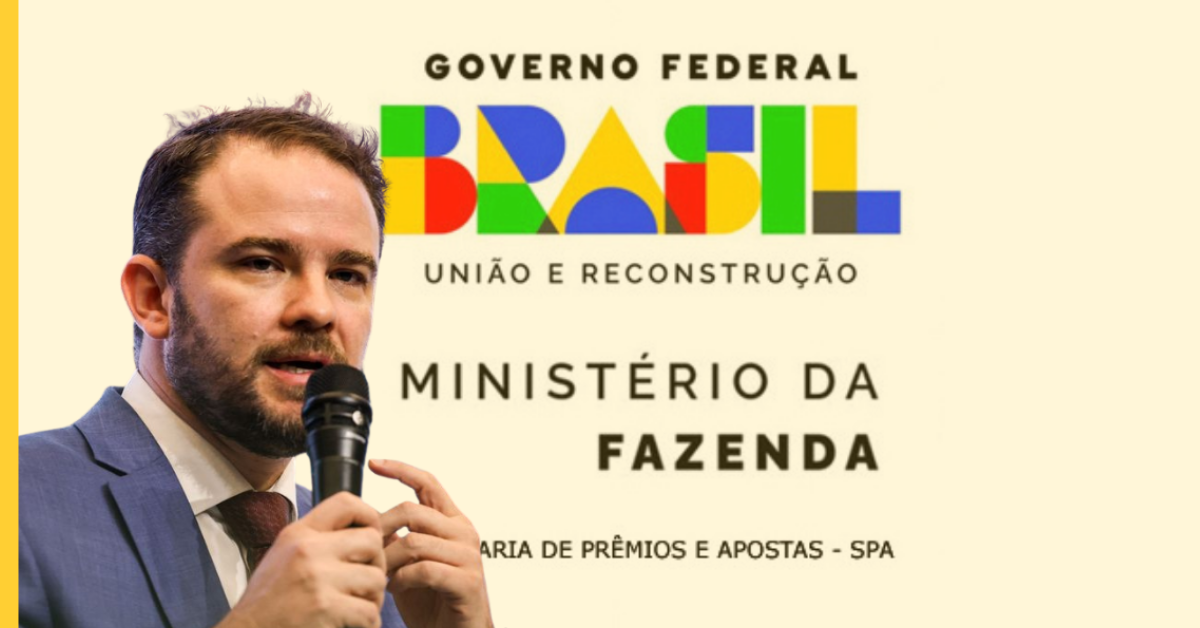
The model will follow the standard used for cigarette advertising, with warnings about health damage and financial losses. Dario Durigan, Minister of Finance, made the announcement in Beijing on Friday (26).
The Ministry of Finance will announce a determination requiring the display of loss-risk warnings after sports betting advertisements in Brazil.
The goal, according to the head of the Finance Ministry, is to show consumers that betting causes health and financial harm. The ministry says it will work to have the measure already in effect for the elimination stage of the World Cup.
“When we have this incentive toward bets, it’s always important to remind our readers that betting is bad for your health, just like cigarettes. The Ministry of Finance, in the case of bets, warns: betting is bad for your health, it makes you lose money,” said Durigan.
The ministry is studying the most appropriate legal format, possibly a provisional measure, and intends for the requirement to already be in force during the elimination stage of the World Cup.
The decision was accelerated by the investigation opened by the Ministry of Justice into the airing of betting advertisements during CazéTV broadcasts on YouTube.
The trigger
The opening of the investigation was motivated, in part, by a letter from federal deputy Erika Hilton (PSOL-SP) to the Federal Public Prosecutor’s Office requesting a ban on commentators advertising bets during games, and by another inquiry to look into possible irregularities in the broadcasting of such ads during CazéTV’s coverage of the 2026 World Cup.
CazéTV, the official broadcaster of the World Cup on YouTube, which broke all previous audience records, stated it had not been informed about the opening of the investigation. “Our commercial activations strictly follow current Brazilian legislation, Conar guidelines and industry best practices, and we work exclusively with operators regulated by the Ministry of Finance,” the company said in a statement.
The measure has precedents: in May 2025, the Senate approved Bill 2,985/2023, which is still awaiting a vote. The bill bans active athletes, artists, broadcasters, influencers and authorities from appearing in betting advertisements, and makes it mandatory to include the phrase “Betting causes dependency and harm to you and your family” in all advertising pieces.
The bill is awaiting a vote in the Chamber of Deputies. In an episode that anticipated the debate, the Ministry of Finance itself was the target of criticism after posting content on Instagram urging the public to “bet responsibly,” language that followers interpreted as normalizing betting. The most criticized portion was removed.
What other countries are already doing
The Brazilian requirement under discussion places the country within a global movement toward tighter regulation of betting advertising, though it still lags behind markets that have moved faster.
In Argentina, advertising is allowed but conditional: operators must be licensed by the regulator of the jurisdiction (LOTBA in CABA, IPLyC in the Province of Buenos Aires, and equivalents in other provinces), and in general must continuously and visibly display the captions “El jugar compulsivamente es perjudicial para la salud” and “+18,” occupying at least 10% of the ad’s height. The participation of minors and the promotion of unlicensed platforms are prohibited.
Unlike countries such as Italy, Belgium, the Netherlands, Lithuania and Croatia, which have already approved binding bans including restrictions on celebrities and influencers, the changes proposed by Spain, regulated by the Dirección General de Ordenación del Juego (DGOJ), are still under consultation, with the legal landscape complicated by the 2024 Supreme Court ruling.
In the United Kingdom, only operators licensed by the Gambling Commission may advertise, under ASA rules that prohibit irresponsible content, association of gambling with financial or sexual success, and any appeal to minors, effectively banning the use of athletes and youth-culture influencers. Since 2019, the voluntary “whistle-to-whistle” agreement has banned TV ads during live sports broadcasts, from kickoff to final whistle.
Cigarettes, alcohol, and now bets
The comparison with cigarettes, made by Minister Durigan himself, is not new. The 1988 Federal Constitution already states in Article 220 that advertising for tobacco, alcoholic beverages, pesticides and medicines must include a warning about the harm resulting from their use — this is the constitutional basis on which any regulation for bets would also rest.
In Brazil, cigarettes are the most restrictive model: advertising on TV and radio is banned, packaging must display mandatory shock images, and advertising in other media is limited to the brand name.
Alcoholic beverages occupy an intermediate level, Law 9,294/1996 requires warning clauses such as “Drink in moderation” and restricts broadcast times on TV and radio, but allows massive advertising.
Opinion of Ana Bárbara Teixeira, a lawyer specializing in Regulatory Law at ABRAJOGO: “Amid the unnecessary controversy that led to the removal of the phrase ‘play responsibly’ by SPA, it is time to restore rationality to the debate on gambling regulation in Brazil.
“Regarding the strident attacks: the country has, democratically, made a mature decision aligned with global consensus by regulating gambling as a legitimate social phenomenon, a form of entertainment that, like the responsible consumption of alcohol, should be practiced in moderation and with awareness.”
“It is up to the regulator to firmly defend this essential message. Far from being optional, the inclusion of the warning was legitimate and mandatory, fulfilling the institutional duty of protecting the regulated market. ‘If you’re going to play, play responsibly’ is not a one-off slogan, but the civilizational foundation of the regulation itself, a premise that must be propagated with conviction by all social agents, operators, media, and authorities,” concludes Teixeira.