
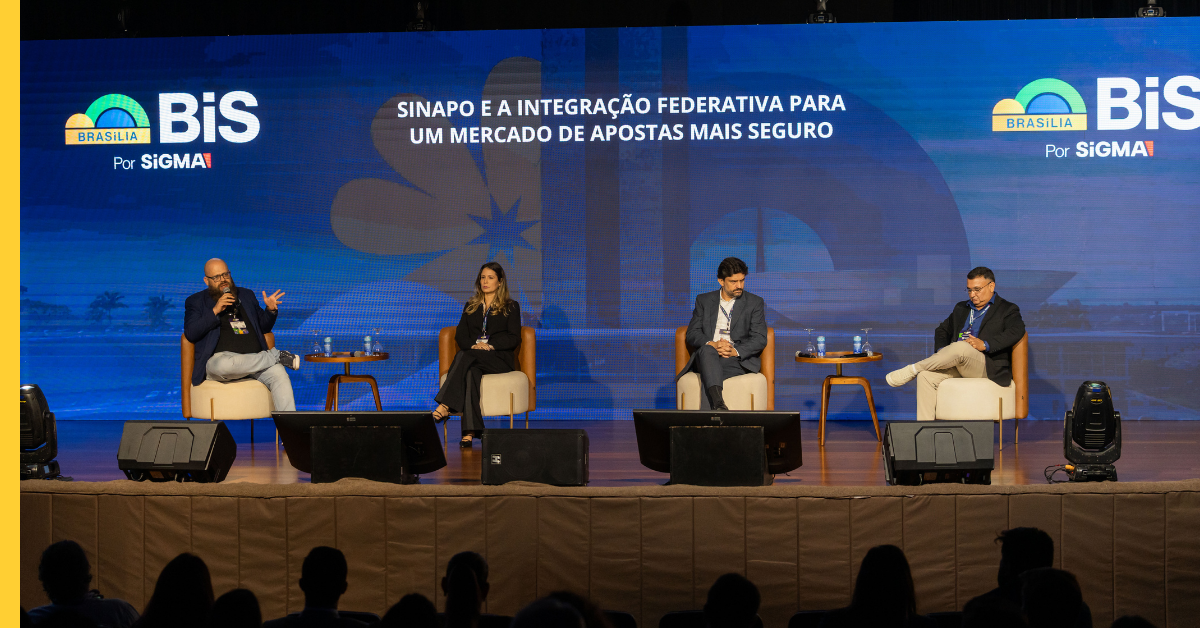
The federal capital was the epicenter of the iGaming sector in Latin America during the second edition of BiS Brasília 2026, held at the Royal Tulip Alvorada Hotel on June 2 and 3.
Bringing together lawmakers, federal regulators, financial oversight bodies, and top-level executives, the two-day forum went beyond general regulatory debates to address the complex operational realities of the already established betting market in Brazil.
Thus, the discussions focused heavily on strict enforcement, as well as financial tracking and the evolving role of state-level operations within the federal market.
One of the main topics discussed was the strengthening of the Betting Management System (SIGAP), run by the Secretariat of Prizes and Betting (SPA) of the Ministry of Finance. Government representatives highlighted the platform’s evolution, which is playing an increasingly relevant role in monitoring authorized operations and overseeing the market.
The discussions also addressed the integration between different public bodies to expand the sector’s supervisory capacity. The expectation is that cooperation between entities such as the Central Bank, the Federal Revenue Service, and Anatel will help combat irregular operators and block financial activities linked to companies unauthorized to operate in the country.
Federative integration
The panel “SINAPO and federative integration for a safer betting market” discussed the proposal to create the National Betting System (SINAPO) as a cooperation tool between the Federal Government, states, and the Federal District.
The debate featured Fabíola Esteves, president of Loterj, Giovanni Rocco Neto, national secretary of Sports Betting at the Ministry of Sport, Waldir Marques, director of International Relations and Regulation at Todos Querem Jogar, and was moderated by Leonardo Benites, coordinator of ANJL.
Likewise, participants advocated for building mechanisms that would allow greater regulatory alignment among federative entities, preserving state-level authority while strengthening the integrity of the national market.
Another point highlighted was the need to establish clear rules for the coexistence between state operations and the federal licensing model, seeking legal certainty for investors and operators.
AML and governance
Anti-money laundering prevention was among the central themes of the event. The panel “Follow The Money – Integrity, Governance, and Anti-Money Laundering Prevention” brought together Ricardo Saadi, president of COAF, Ana Helena Pamplona, legal director of ABRAJOGO, and Matheus Vidal, Head of Legal at Paag.
During his participation, therefore, Saadi highlighted the importance of regulation in increasing the sector’s transparency and praised the efforts made by the industry to strengthen control mechanisms.
“We know that BiS’s work has been serious, seeking to bring integrity to the sector, and therefore, I made a point of being present, representing the body I work for. Above all, the regulated betting sector follows good practices and is in compliance with Brazilian laws. Furthermore, the market has constantly sought mechanisms to prevent money laundering,” he stated.
Moreover, the event brought discussions on the use of technology and data intelligence for risk identification, fraud prevention, and monitoring of suspicious behavior.
Data intelligence
Right after, the panel “Complete iGaming Overview: What Real Betting Data Reveals,” with Eduardo Franceschett, from Safefy, brought a strategic analysis of real betting data, revealing behavior patterns, fraud risks, signs of money laundering, and signs of problem gambling, showing how technology, compliance, and predictive intelligence strengthen the security of the regulated market.
The session “Beyond betting: credit, consumption, and responsibility in understanding Brazilian indebtedness,” with Ana Bárbara Teixeira, Director of Government Relations at ABRAJOGO, Victor Yuki Oda, from Serasa, and Rodrigo Marinho, executive director of Instituto Livre Mercado, stated that Brazil “has a disease called the State,” clarifying that the fault lies not with the bets but with the state itself.
Responsible gambling and the fight against the illegal market
The creation of a safer environment for consumers also took center stage on the agenda.
The panel “Responsible gambling and innovation as pillars for building an integrated network of humanized care” brought together representatives from the private sector, compliance specialists, and public health professionals to discuss prevention mechanisms and care for people with betting-related disorders.
For this reason, the topics covered included the use of monitoring technologies, alert systems for risky behaviors, and integrated care models combining digital assistance with specialized support.
For Fellipe Fraga, CBO of Stellar Gaming, one of the main points of consensus reached during the event was the need to step up the fight against the illegal market.
“The talk had a very high technical level and managed to convey an urgent message to the market. We talked about prevention, detection of risky behaviors, responsible communication, and, above all, about the need to combat the illegal market, which today represents one of the biggest challenges for consumer protection and for the industry’s development,” he stated.
According to the executive, the regulated sector has been investing heavily in technology, compliance, and responsible gambling mechanisms, but the progress of these initiatives depends on reducing the space occupied by unauthorized operators.
The closing of the event reinforced that the Brazilian fixed-odds betting ecosystem increasingly demands operational maturity, robust governance, and technological infrastructure compatible with federal oversight mechanisms.